
Statement: This series of post records the personal notes and
experiences of learning the BiliBili video tutorial "Pytorch
入门学习", most of code and pictures are from the courseware PyTorch-Course.
All posted content is for personal study only, do not use for other
purposes. If there is infringement, please contact
e-mail:yangsuoly@qq.com to delete.
1. Introduction to deep learning models
1.1 Definition
Q: What is machine learning?
A: Study of algorithms that: - Improve their
performance P - At some task T - With
experience E
Conclusion: Modeling, Inference, learning 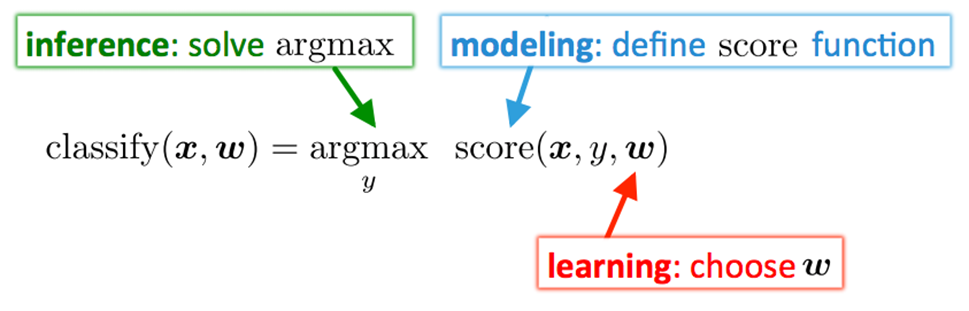
- Modeling: define score function
- Inference: solve argmax
- Learning: choose w
\text{classify} (x, w) = \mathop{\text{argmax}}\limits_{y} \ \text{score} (x, y, w)
Q: What is deep learning? A: 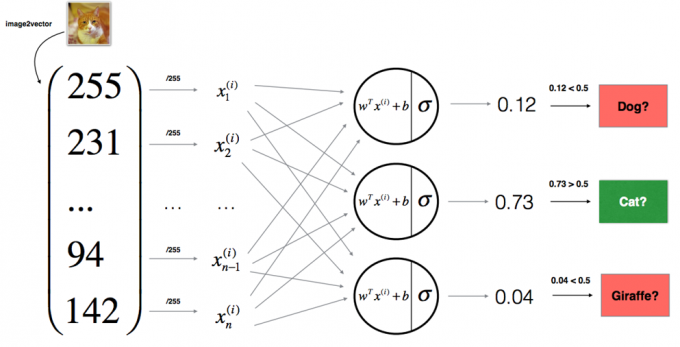
Q: What is neural network? A: 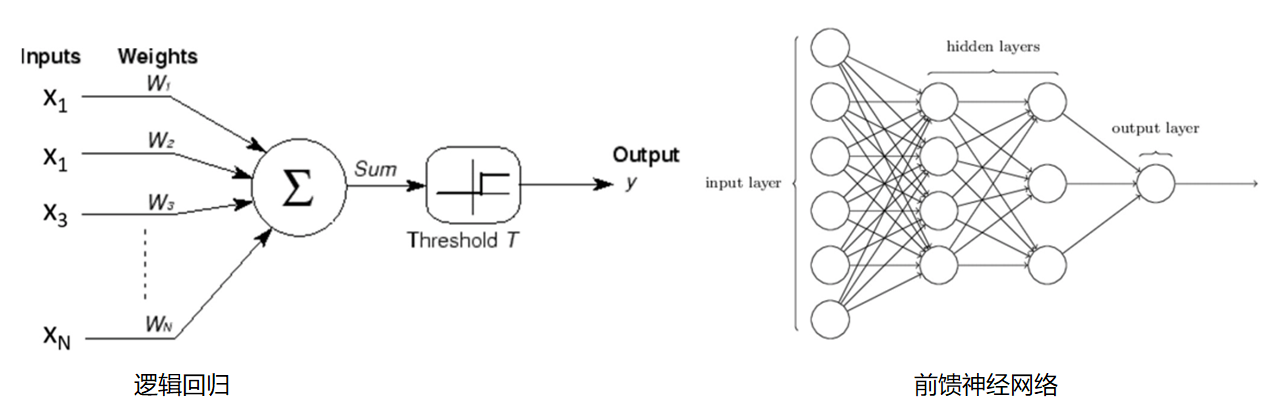
1.2 Activation function
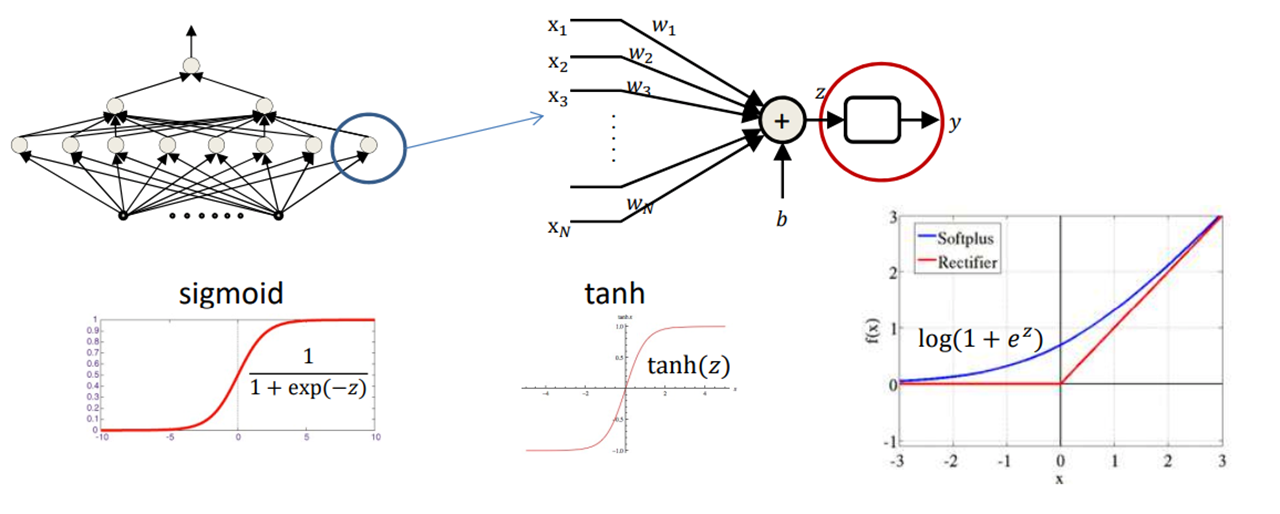
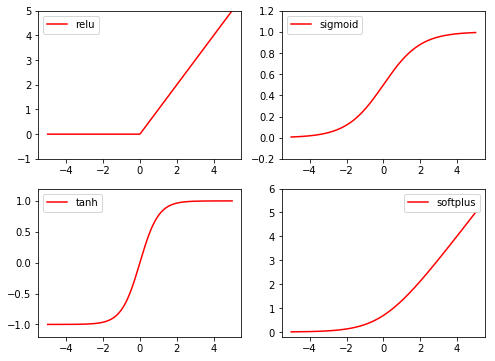
1.2.1 Commonly used activation functions:
sigmoid: \sigma(x) = \frac{1}{1+e^{-x}}
tanh: tanh(x) = 2 \sigma(2x) - 1
ReLU: ReLU(x) = max(0, x)
Softmax: z_i \rightarrow \frac{e^{z_i}}{\sum_{j=1}^{k} e^{z_j}}
1.2.2 Code implementation
1 | import torch |
Result:
1.3 examples of NN
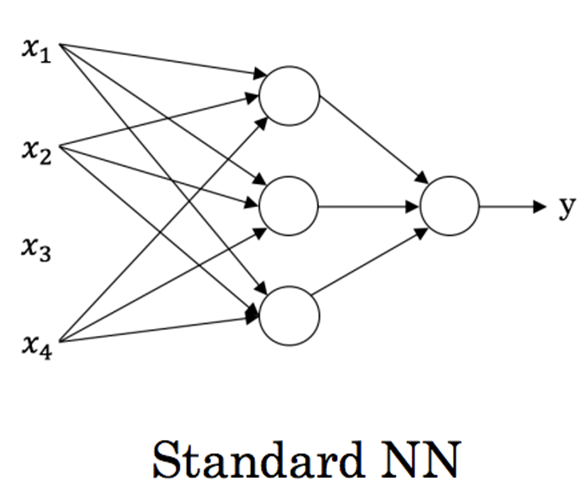
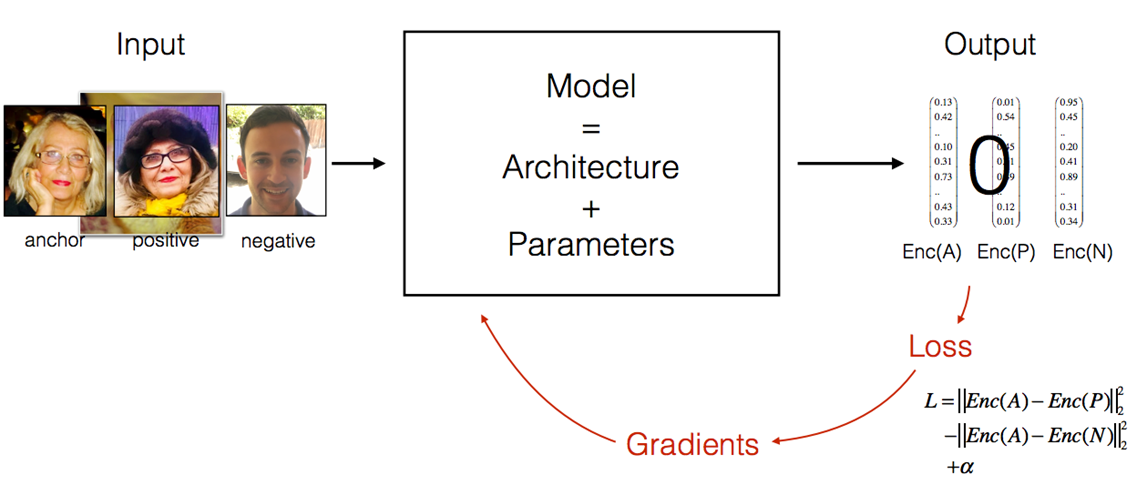
Standard feedforward NN
Convolutional NN

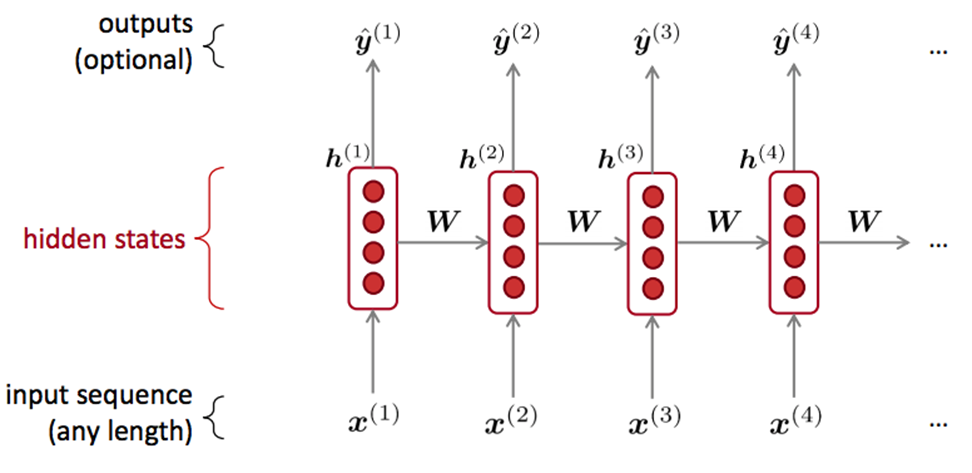
Recurrent NN
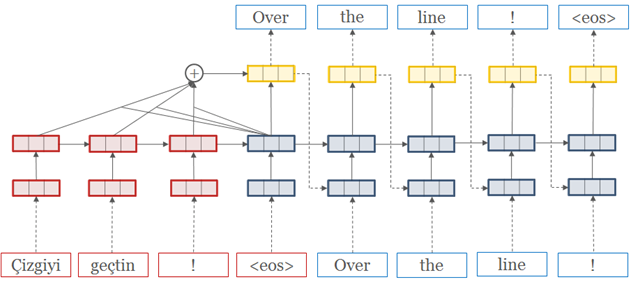
Seq2Seq with Attention
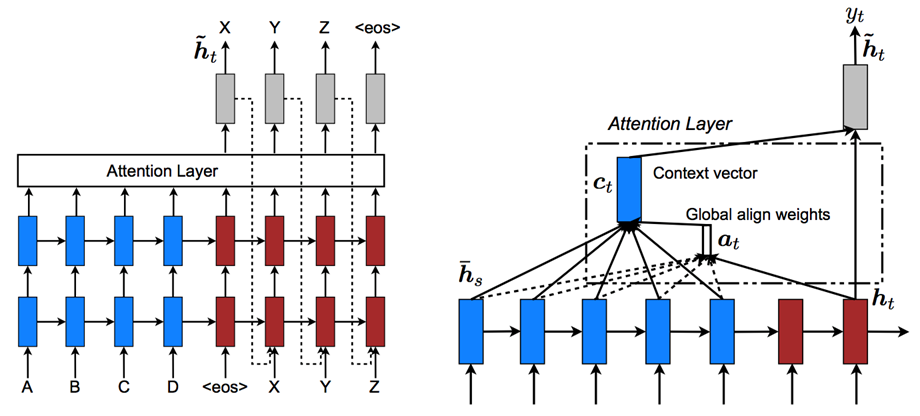 Reference: Effective Approaches to
Attention-based Neural Machine Translation
Reference: Effective Approaches to
Attention-based Neural Machine Translation
2. Introduction to PyTorch
2.1 Framework for deep learning
Difference between PyTorch and Tensorflow: - PyTorch: 动态计算图 Dynamic Computation Graph - Tensorflow: 静态计算图 Static Computation Graph
PyTorch 代码通俗易懂,非常接近 Python 原生代码,不会让人感觉是完全在学习一门新的语言。拥有 Facebook 支持,社区活跃。
Q: What does the PyTorch do? A:
2.2. Some interesting project with PyTorch
ResNet
 Image classification: ResNet
Object Detection
 Project address:
Here
Project address:
HereImage Style Transfer
 Project address:
Here
Project address:
HereCycleGAN
 Project address: Here
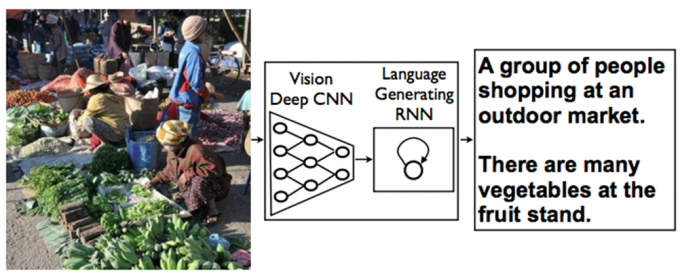
Image Captioning
 Project address:
Here
Project address:
HereSentiment Analysis
 Project address: Here
Question Answering
 Project address: Here
Translation: OpenNMT-py
 Project address: Here
ChatBot
 Project address: Here
Deep Reinforcement Learning
2.3 How to learn PyTorch
- Basics of deep learning;
- Pytorch official tutorial;
- Learn tutorials on GitHub and various blogs;
- Documentation and BBS
- Re-creat the open source PyTorch project;
- Read papers about deep learning model and implement them;
- Create your own model.
3. Note content
- Pytorch framework with autograd introduction, simple forward neural networks;
- Word vector;
- Image classification, CNN, Transfer learning;
- Language Model, Sentiment Classification, RNN, LSTM, GRU;
- Translation Model, Seq2Seq, Attention;
- Reading Comprehension, EIMo, BERT, GPT-2;
- ChatBot;
- GAN, Face generation, Style Transfer.